

Whether teaching, investigating, or tinkering on the road, there’s an undeniable appeal to a device that’s self-contained, headless, and versatile enough to support forensic analysis, malware triage, and field acquisition. That idea became the seed for Toby — a Raspberry Pi Zero 2 W–based micro-rig that can be managed from an iPad or mobile device.
It started off with a “what could I do with at Raspberry Pi” and the final result: a fully functional, go-anywhere forensics toolkit that fits in the palm of your hand, carefully packed into a Grid-It travel kit and loaded with purpose.
Why Build Toby?
Toby wasn’t born from necessity. It came from a blend of curiosity, constraint, and the spirit of joyful overengineering. The goal wasn’t just to get Kali Linux running on a Pi — that’s been done. The challenge was in how much capability could be packed into a minimalist footprint without compromising on control, security, or style.
Some driving goals from the outset:
- Headless-first: Must be operable via SSH, or VNC — no screen needed.
- Kali-based: Full access to familiar forensic and pentest tooling.
- Discreet and functional: Everything should be secure, practical, and stowable.
- Modular connectivity: USB OTG, video capture, remote keyboard/mouse, and VPN support all needed to be viable.
- Portable power: Run from a battery pack for field ops or demo use without dependency on AC power.

Hardware Selection
Raspberry Pi Zero 2 W
The Pi Zero 2 W hits a sweet spot. It has enough power to run full Kali and perform triage analysis, especially with swap and careful headless tuning. It supports USB OTG and can be powered over micro-USB, making it ideal for lightweight builds.
Grid-It Travel Kit: The Physical Layout
Instead of housing the components in a fixed enclosure, I opted for flexibility: a Grid-It organizer sleeve. It allows each cable and tool to remain accessible and secured via elastic straps — perfect for quick swaps or field reconfiguration.
The current loadout includes:
- Raspberry Pi Zero 2 W
- HDMI mini to full adapter (for display recovery if needed)
- USB micro to USB-C adapter combo (for powering Pi from laptop, iPad, or battery pack)
- Anker battery pack (portable, long runtime)
- Wireless keyboard (compact; paired via Bluetooth or USB receiver)
- USB capture device (used for teaching, demoing webcam/VNC sessions)
- Short USB OTG cable
The setup is light, self-contained, and TSA-friendly — a true digital go-bag for the forensically inclined.

Portable Power
Toby can be powered from the USB port of an iPad or from a battery pack or AC adapter, making it extremely flexible for field use.


Software
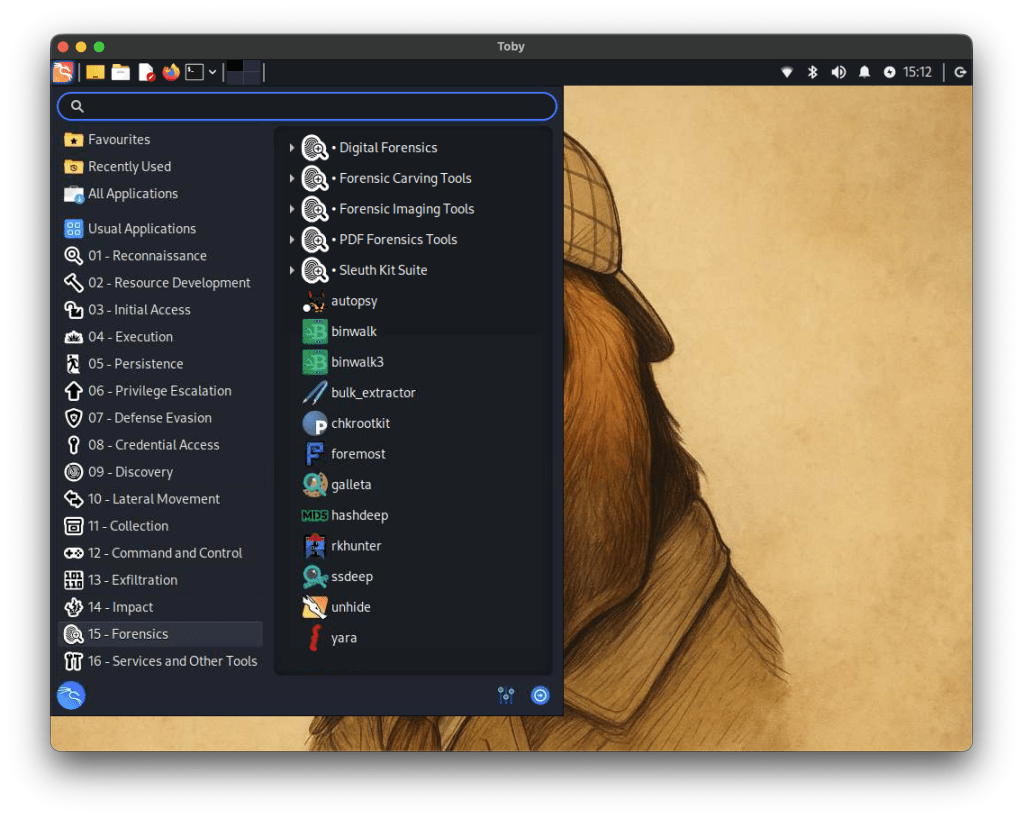
The OS is a clean, headless Kali Linux image configured specifically for ARM on the Pi Zero 2 W. Rather than trying to turn it into a desktop experience (even though it can), it boots fast, runs lean, and drops me directly into a terminal where I can get to work — whether over SSH or local keyboard.
Core Components:
• Base image: Raspbian (Debian-based) with Kali tools manually installed
Metapackages:
- kali-linux-forensic
- kali-linux-desktop
- core/default Kali utilities and command-line tools, incrementally layered until the system was functionally equivalent to a full Kali install (minus unnecessary services)
Additional Software Intstalled:
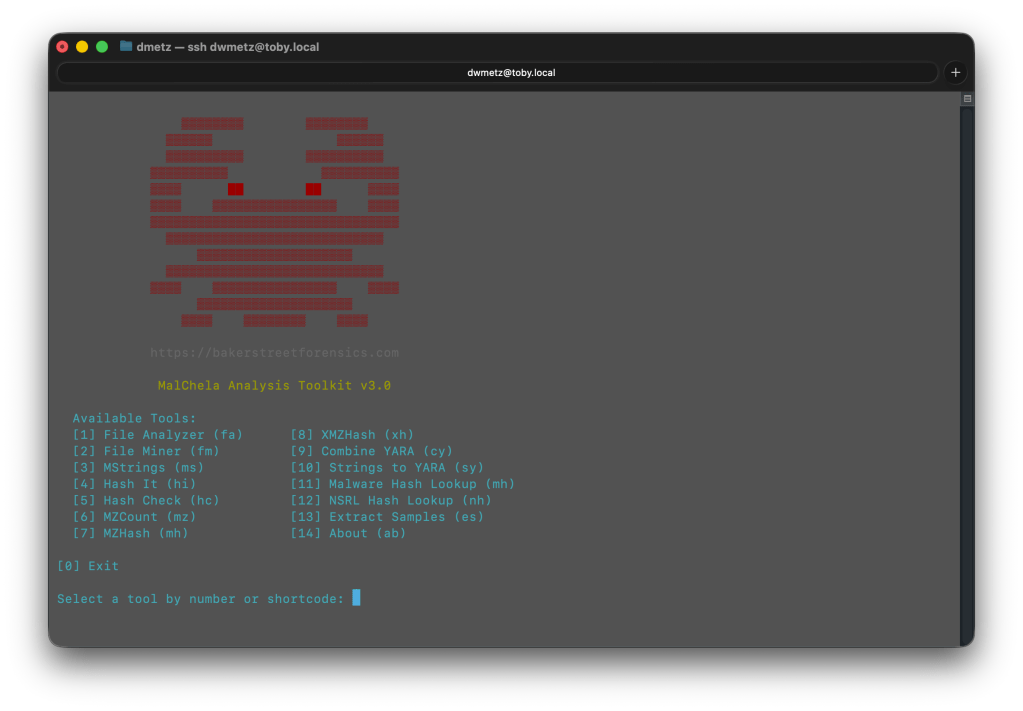
- MalChela (CLI and GUI)
- Toby-find

🔍 Toby-find: Your On-Device Forensics Cheat Sheet
One of Toby’s handiest features isn’t a tool you run—it’s a tool to remember tools. toby-find is a simple but powerful command-line helper built into the system. It gives you fast access to a curated list of CLI forensics tools available on Toby, along with short descriptions and usage tips.
It’s like having a searchable cheat sheet, always available—perfect for field use when memory is fuzzy or connectivity is limited.

What It Does
When you run:
toby-find [keyword] it will search the help file for any tool(s) mentioning the keyword in name or description, and provide back a simple command syntax for each tool.
Example:
dwmetz@toby:~$ toby-find strings

Tool:        mstrings
Description: Extracts printable strings from files and maps them to MITRE ATT&CK techniques.
Example:     mstrings suspicious.exe
Category:    Malware
--------------------------------------------------
Tool:        strings_to_yara
Description: Generates a basic YARA rule from strings gathered manually or via mstrings.
Example:     strings_to_yara
Category:    Malware
--------------------------------------------------
Tool:        floss
Description: Extracts obfuscated strings from malware binaries.
Example:     floss suspicious.exe
Category:    Forensics
--------------------------------------------------
Tool:        rephrase
Description: Analyzes and reformats strings from documents or binaries.
Example:     rephrase input.txt
Category:    Forensics
--------------------------------------------------
Installed Tools:
Many of the tools are native to Kali, but some, including MalChela, were compiled manually or added through custom scripts. (Bold == MalChela tools or custom scripts.)
| Tool Name | Description |
|---|---|
| bat | Cat replacement with syntax highlighting and Git integration. |
| binwalk | Scans binaries for embedded files and executable code. |
| bulk_extractor | Extracts artifacts like emails and credit card numbers from disk images. |
| combine_yara | Combines multiple YARA rule files into a single merged rule set. |
| dff | Digital Forensics Framework with CLI and GUI modes. |
| dig | Performs DNS lookups to retrieve domain IPs and records. |
| exiftool | Displays metadata from images, PDFs, and other file types. |
| extract_samples | Extracts files from password-protected ZIP and RAR archives. |
| fileanalyzer | Analyzes file metadata, headers, and hashes to assist triage and detection. |
| fileminer | Recursively scans a directory for files of interest based on extensions and type. |
| floss | Extracts obfuscated strings from malware binaries. |
| foremost | Recovers deleted files from disk images using file carving. |
| hashcheck | Computes multiple cryptographic hashes and prints them side-by-side. |
| hashdeep | Generates and verifies file hashes for entire directories. |
| hashit | Quickly generate MD5, SHA1, SHA256, and SHA512 hashes of a file. |
| htop | Interactive system monitor showing real-time process usage. |
| ipcalc | Performs subnet calculations for IP ranges. |
| ipstatus | Shows interface configuration and public IP address. |
| malchela | Main CLI launcher for the MalChela forensic toolkit, with a menu-driven interface. |
| malhash | Looks up file hashes using VirusTotal and MalwareBazaar. |
| mosh | SSH replacement that maintains session state during roaming. |
| mstrings | Extracts printable strings from files and maps them to MITRE ATT&CK techniques. |
| mzcount | Tallies file extensions and MIME types in a directory. |
| mzhash | Recursively hash all files in a directory using MD5. |
| ncdu | Disk usage analyzer with an interactive interface. |
| nmap | Performs host discovery and port scanning on a network. |
| nsrlquery | Checks file hashes against the National Software Reference Library. |
| p0f | Performs passive OS fingerprinting from live network traffic. |
| reglookup | Queries Windows Registry hives from the command line. |
| regripper | Extracts and parses registry artifacts using Perl-based plugins. |
| rephrase | Analyzes and reformats strings from documents or binaries. |
| rifiuti2 | Parses Windows Recycle Bin INFO2 files for forensic analysis. |
| rkhunter | Scans the system for known rootkits and suspicious behavior. |
| rsakeyfind | Searches RAM dumps for RSA private key patterns. |
| safecopy | Recovers data from damaged or unstable storage media. |
| samdump2 | Extracts password hashes from Windows SAM files. |
| scalpel | Performs file carving on disk images using headers/footers. |
| screen | Terminal window manager similar to tmux. |
| scrounge-ntfs | Recovers deleted files from NTFS file systems. |
| speed | Performs a network speed test from the command line. |
| ssh | Standard secure shell for remote command-line access. |
| ssdeep | Performs context-triggered piecewise hashing (fuzzy hashing). |
| strings_to_yara | Generates a basic YARA rule from strings gathered manually or via mstrings. |
| tcpdump | Captures and displays raw network packets in real time. |
| tmux | Terminal multiplexer for managing multiple sessions. |
| toby-find | Lists available tools and examples installed on the Toby system. |
| truecrack | Attempts to brute-force passwords for TrueCrypt volumes. |
| tshark | Terminal version of Wireshark for packet capture and filtering. |
| undbx | Extracts messages from Outlook Express DBX mailboxes. |
| unar | Extracts files from .rar and other archives. |
| unhide | Detects hidden processes and tasks in Linux systems. |
| upx | Compresses or decompresses executable files. |
| uptime | Displays system uptime and load averages. |
| vinetto | Parses thumbnail caches from Internet Explorer and Firefox. |
| vnc-off | Stops the running VNC session. |
| vnc-on | Starts a VNC server session for remote desktop access. |
| volatility3 | Memory forensics framework for analyzing RAM dumps. |
| vpn-off | Stops the active OpenVPN session. |
| vpn-on | Starts the OpenVPN client using the configured lab connection. |
| winregfs | Mounts Windows Registry hives as a read-only virtual filesystem. |
| xmount | Converts between forensic image formats (e.g. EWF to RAW). |
| xmzhash | Recursively hash all files in a directory using MD5, SHA1, and SHA256. |
This setup enables lightweight static analysis, file triage, memory inspection, and network capture — all from a Pi that fits in a Altoids case.
Build Process (Step by Step)
1. Flashing and First Boot
Using the Raspberry Pi Imager, I selected the ARM64 Raspbian image, added SSH and Wi-Fi credentials, and flashed the SD card.
Tip: The “advanced” options in Raspberry Pi Imager let you configure headless behavior up front, saving time on first boot.
2. Swap, Networking, and System Setup
The Pi Zero 2 W is modest on RAM — just 512MB — so swap is essential. I configured a persistent 2GB file-based swap at /swapfile, which gave the system enough breathing room to compile, run heavier tools, and avoid out-of-memory crashes during extended sessions.
Networking is Wi-Fi-only, so multiple SSIDs were configured using wpa_supplicant.conf for home and hotspot SSIDs. VPN has also been configured for remote access to my home malware lab.
3. Building and Installing MalChela
I cloned the full MalChela repository directly and compiled tool-by-tool:
cd MalChela
for tool in fileanalyzer mstrings hashcheck extract_samples ...; do
  cargo build --release -p $tool
done
4. Screen Choices
In addition to headless-mode, you can use a typical keyboard/monitor/mouse setup, for either cli mode or full gui.
The Pi Zero 2 W supports HDMI output via its mini-HDMI port, so you can plug it directly into any monitor or TV using a mini-HDMI to HDMI cable or adapter. For true portability, I needed something more flexible that didn’t require me packing a separate screen.

To solve this, I added a compact USB-based HDMI capture device to the kit. It effectively turns any mobile device into a live monitor. By connecting Toby’s HDMI out to the capture card and plugging it into my iPad or iPhone, I can preview the Pi’s screen on the go. This setup also works with OBS, QuickTime, or dedicated capture apps for recording demos or screen sessions — handy for teaching or documenting tool usage.
Input is handled with a small wireless Bluetooth keyboard, which pairs cleanly with Toby for direct control. This combo — Pi output through HDMI capture and keyboard input via Bluetooth — lets me interact with Toby completely untethered.
In practice, I rarely need the GUI. But when I do, this setup lets me bring it up quickly without dragging along a dedicated screen.
Final Result: What Toby Can Do
Toby isn’t just a cute Pi rig with a name. It’s a real tool, and its current feature set reflects that.
💼 Mobile Forensics Platform
- Mount, triage, and scan USB drives with fileanalyzer
- Run YARA scans and generate custom rules from strings
- Look up hashes via VirusTotal, MalwareBazaar, and NSRL
- Analyze memory dumps with Volatility 3 (including plugin selection)
- Run offline IOCs scans via mstrings or custom shell scripts
What’s Next for Toby
Building Toby was an exercise in maximizing power in a small footprint through deliberate choices. For educators, students, and curious tinkerers, Toby proves that hands-on, portable, and fun learning and teaching forensics can be achieved. If you’re building your own, start with what you have: a Pi, a Grid-It, and your imagination. Sometimes, the best tools aren’t the ones with the biggest screens or fastest chips—they’re the ones you have with you.
I’m already thinking about upgrades. One in consideration is a case upgrade, a true lunchbox-style metal enclosure — something retro and rugged, with a small screen inside the lid.
Let me know in the comments if you’d like a public release of toby-find as an add-on to install for Kali builds for forensics and malware analysis.




 Baker Street Forensics